The French Topogulf study was an impressive undertaking to explore fluid motion in the vicinity of mid-Atlantic ridge. As noted in the previous post a major objective concerned fluid exchange across the ridge, which, it turned out, was very limited despite significant eddy activity on both sides. In this post I zoom in on a few float tracks to illustrate strikingly different kinds of action in the ocean. While these are but a few arbitrary choices from a rich data set, they emphasize the enormous descriptive power of the Lagrangian approach to studying oceanic motion.
The reason is simple. The most energetic motions in the ocean have quite small horizontal scales - measured in 10s of km. The only tool we have for visualizing these motions at depth is the neutrally buoyant float that drifts with the water around it. And it does so very effectively as these examples show. Consider the anticlockwise swirl of 7 trajectories in this figure:
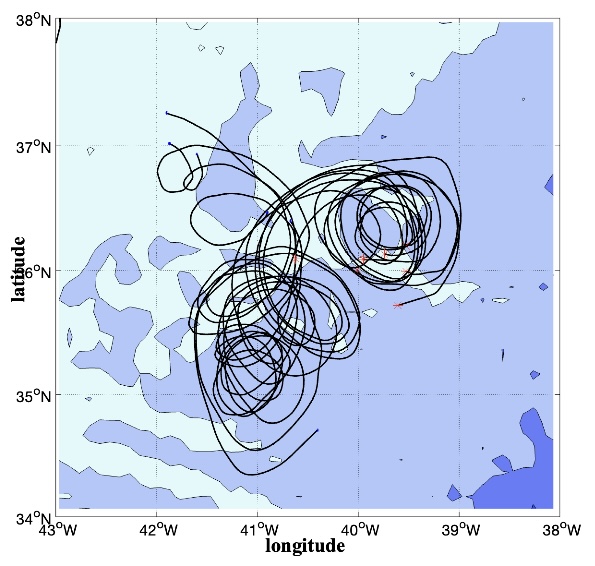
They reveal a cyclonic eddy drifting to the southwest. A concurrent surface drifter showed that the eddy had a surface expression. We don’t know where and how it was formed, but it is tempting to guess that it broke off from a large meander of the Azores Current – a branch of the Gulf Stream - near where it crosses the mid-Atlantic ridge. While these floats eventually escape from the eddy, we know from other studies that coherent features like this one can remain intact for years since they are inherently stable. They could probably last ‘forever’ if left alone. How long they last will depend upon external threats, the most obvious one being strong lateral shear in fronts. As cyclonic eddies age they tend to drift toward higher f/H regions, which in this case means it likely stayed close to the ridge.
The next figure shows two floats that after looping around the eddy and remained with 10 km of each other for roughly 50 days before separating near 45°W. What I find striking about this pair is its rapid ~400 km nearly recti-linear displacement, some 10x greater than the radius of deformation, the dominant eddy scale. The blue track continues north (visible for first 170 days) while the red one turns south and wanders about mostly cyclonically including a striking excursion north and back across the mean path of the Gulf Stream (at ~40°N).
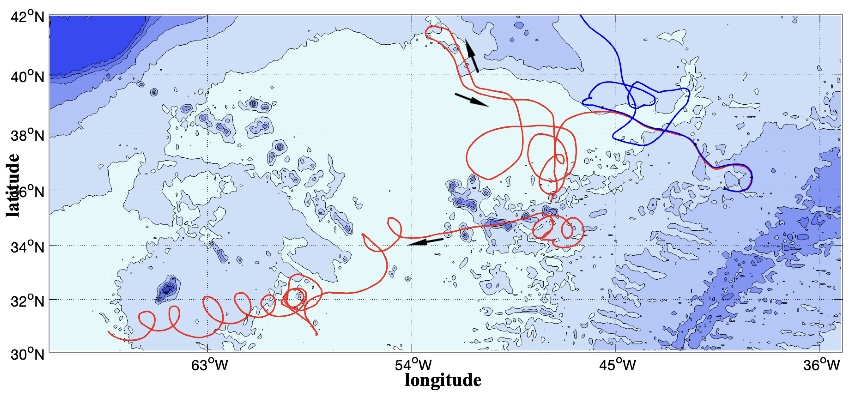
The red float lasted 788 days during which time it drifted 2500 km to the west. But it is the anti-cyclonic (clockwise) looping that caught my eye. Ever since Scott McDowell and I wrote about the ‘meddy’ we found off the Bahamas and given the striking spread of Mediterranean water across the North Atlantic, we figured there should be others. Indeed, our finding led to the search for and discovery of numerous similar features in the eastern North Atlantic that became the focus of considerable research. However, these studies also showed it highly unlikely that the Bahamas ‘meddy’ could have come from the Mediterranean! But if not, from where? We didn’t have a clue until by chance we discovered that it must have come from the Northwest Corner (Prater and Rossby, 1999). We can’t be certain, but it seems plausible that the looping that starts at about 59°W in the bottom figure is when the float gets snared by such an eddy or lens as we sometimes call them. When Prater and I wrote our paper we had assumed the ‘meddy’ would have been advected west by the Gulf Stream recirculation gyre north of Bermuda. Our guess wasn’t so bad, this one passes just south of the island. The float remains trapped in the eddy for the last 200 days of its recorded journey. It’s a pretty safe bet that the lens continued on a southerly track.
Unlike the cyclonic eddy in the first slide, ‘meddies’ do not have a surface expression, they cannot be followed from the surface. For this reason these internal eddies are called lenses or disks because they are embedded within in the stratified water column. Thanks to numerous studies using floats we now know that both cyclonic and anticyclonic lenses are quite common in the northern North Atlantic (see my post on spinning disks in the ocean, Aug.12, 2023). How common they are in general I do not know.
Prater, M.D. and T. Rossby, 1999. An alternative hypothesis for the origin of the “Mediterranean” salt lens observed in the Bahamas in the Fall of 1976. Phys. Oceanogr., 29, 2103-2109.