This is a brief follow-up to the previous post about the warming hole to give a bit more detail about the acoustic Doppler current profiler (ADCP) data from the Nuka Arctica transits. The vessel was an ice-reinforced container vessel that operated on a 3-week schedule between Greenland and Denmark. Thanks to the vessel’s deep 6.5 m draft and resultant lack of bubbles the ADCP could operate remarkably effectively in all seasons. On her westbound transits she traveled a great circle route to Cape Farewell but steamed along a constant latitude eastbound. If the weather was exceptionally bad she could avoid rounding the cape by steaming through Prince Christian Sound, but she did this only rarely. Traversing the sound must be a feast for the eye!
The left panel shows all the ship tracks from both operating periods, 1999-2002 (150 kHz ADCP) and 2013-2016 (75 kHz ADCP). While the 150 ADCP continued working for much longer a change in the data acquisition system prevented recovery and processing of the data. But thanks to Dr. Henrik Søiland and Prof. Corinna Schrum the ship was later equipped with the 75 kHz ADCP, which continued to deliver data until the ship was retired.
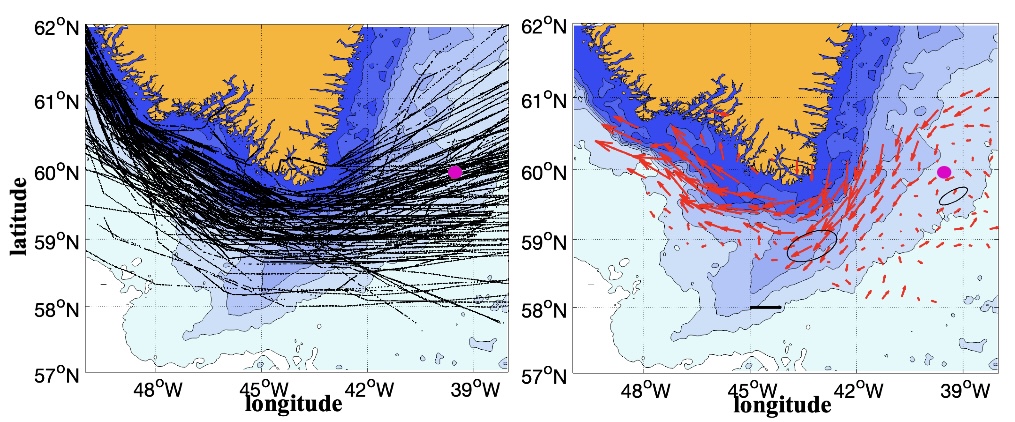
Binning all surface to 500 m velocity data (75 kHz data only) into roughly 25 km square boxes illustrates the mean circulation around southern Greenland. The black line represents 0.5 m/s and the smaller variance ellipse represents 0.0091 m2/s2 eddy kinetic energy or a 9.5 cm/s RMS velocity. Eirik Ridge plays a prominent role in diverging some water away from Greenland to the south as seen in the mean flow and polarization of eddy kinetic energy. Note how sharply the mean flow drops off away from the coastline. The magenta dot is the location of the OOI Irminger Sea buoy.
Today the Royal Arctic Lines operates the Tukuma Arctica between Greenland and Denmark. The vessel makes a port call in Reykjavik, Iceland in both directions. Given the increasing activity around Greenland (RAL) and given the increasing traffic to/from Iceland (Eimskip shipping company) the time is surely ripe to explore the possibility of working with these companies to establish robust coverage of the subpolar North Atlantic circulation.
The next post will summarize a few of the key findings based on or using the Nuka Arctica data.