The impetus for this post comes from Sara Lang’s PhD defense presentation yesterday here at GSO. She was discussing stirring and mixing processes that enhance phytoplankton growth in cold core rings (CCR). Her talk reminded me of some old acoustic Doppler current profiler (ADCP) data we had looked at from the Oleander steaming through CCRs during its transits between New Jersey and Bermuda. The ADCP depends upon backscatterers in the water column to profile currents. Of interest here is the fact that the ADCP also records signal strength, which can be used to get a measure of ‘biomass’ due to zooplankton and myctophids in the water column. The container vessel Oleander has steamed through many CCRs over the years. Luce and Rossby (2008) identified many of these. One case stands out because the Oleander captured the formation of a CCR breaking off from a extended meander trough over a 2-week period.
The three figures each a week apart show the formation of the CCR from the Gulf Stream meander trough. The first figure is curious in that without satellite sea surface temperature we might not have known that the vessel was crossing a meander trough rather than a ring. The second figure shows the newly formed ring, but the center of the ring has yet to be spun up. The third figure shows the core in nearly solid body rotation. Perhaps someone can explain how this can happen so quickly.
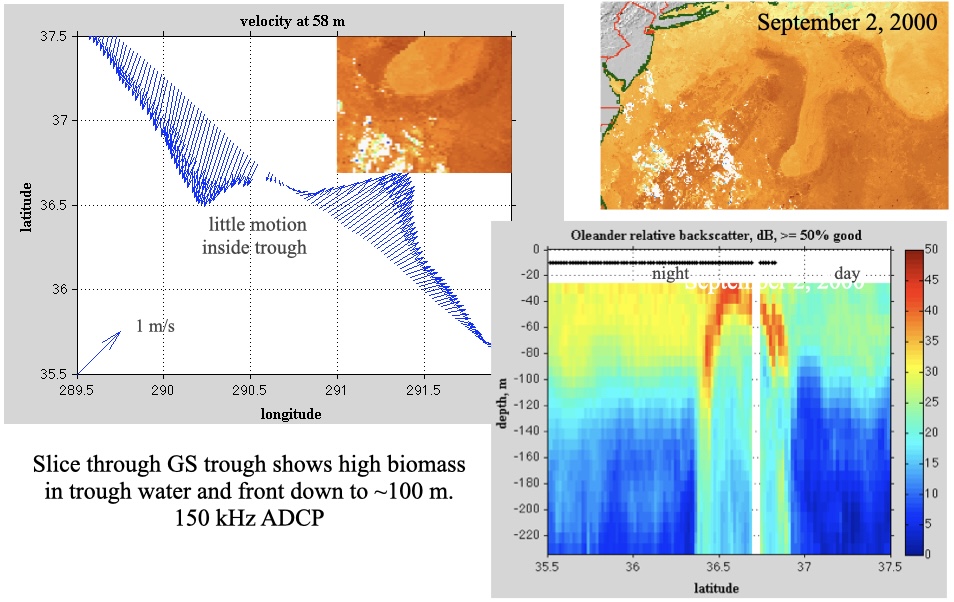
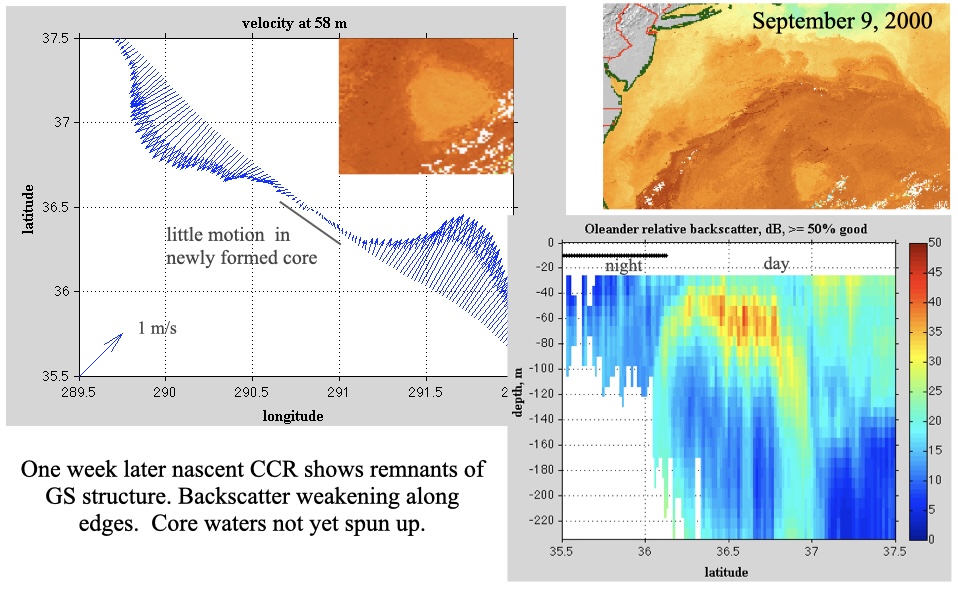
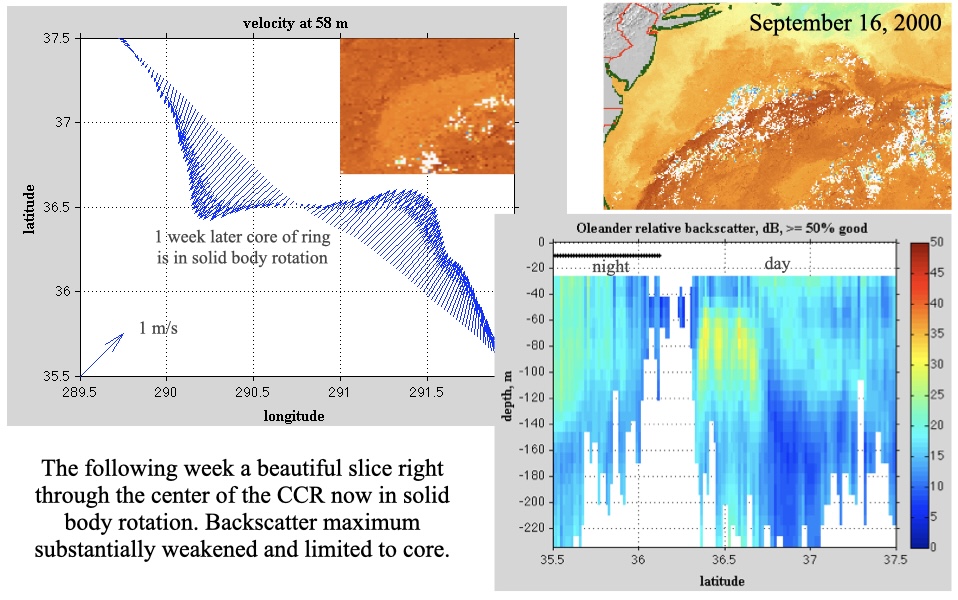
But just as striking is the change in backscatter structure. The first figure shows the slope water inside the trough loaded with backscatterers down the sides to ~100 m. But already in the Oleander‘s transit a week later backscatter material is far more confined to the core of the CCR and a week after that even the core has lost much of its backscatter material. Apparently, while the CCR is spinning up, the core is losing its ‘biomass’. I put biomass in quotes because we don’t know its composition. CCRs can last for many months but they rarely live out a ‘full life’ gradually spinning down for they are often reabsorbed into the Gulf Stream.
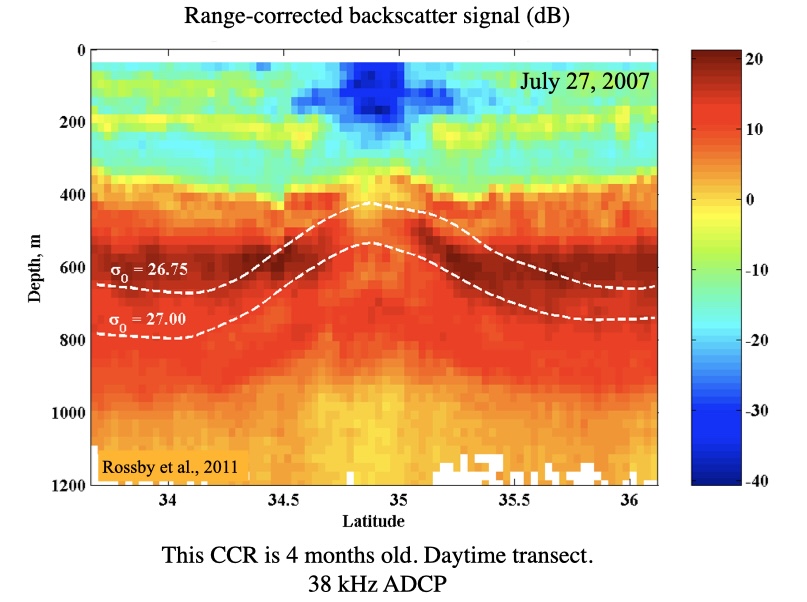
This last figure is from a 38 kHz ADCP slice through a 4-month old CCR in July 2007 (Rossby et al., 2011). The lower frequency reaches to much greater depths. Note the striking bacscatter void in the center of the CCR. But backscatter strength is less in the core of the CCR at all depths suggesting a degree of isolation or trapping of these waters from the surrounding ocean. I dream of the day when we will be able to scan the ocean water column on a regular basis with these kinds of instruments, they can tell us so much - as these figures indicate. Many of my earlier blog posts touch on these issues.
Luce, D. and T. Rossby (2008). On the size and distribution of rings and coherent vortices in the Sargasso Sea, J. Geophys. Res., 113, C05011, doi:10.1029/2007JC004171.
Rossby, T., C. Flagg, P. Ortner, and C. Hu (2011). A Tale of Two Eddies: Diagnosing coherent eddies through acoustic remote sensing. J. Geophys. Res. 116, C12017, doi:10.1029/2011JC007307