The AMOC seems to be on everyone’s minds these days. Articles are coming fast and furious about the imminent collapse or maybe not? of the AMOC. Some writers claim it is already slowing, others disagree. The range of opinions reflect the divergent views about what threatens the AMOC. Since predicting the future is difficult, an important branch of oceanography focuses on the ocean’s role in past climate change. This is the task facing the paleo-oceanographic community. Its activities are incredibly diverse: teasing out past climate as imprinted in the Greenland icesheet, in ocean sediment records of past surface conditions, in tree rings, in the vegetative history of bogs, in the annual varving in quahog shells, etc. Difficult work but extremely valuable. The previous blog post sought to explain the sequence of events that led to the shutdown of the AMOC. Here I use a reconstruction of the paleo-North Atlantic circulation to illustrate what happens when the AMOC shuts down, it is quite dramatic.
Some years ago, I came across a major article by Robinson et al. (1995). While it was very technical and outside my area of activity, it included a figure illustrating what they thought the circulation of the North Atlantic might have looked like during the last glacial maximum, i.e., when the AMOC was shut down. Not only did it seem plausible to me, it really brought out the enormous change in circulation between today (AMOC on), and during glacial times (AMOC off). I colorized it according to the spread of warm water for these two periods.
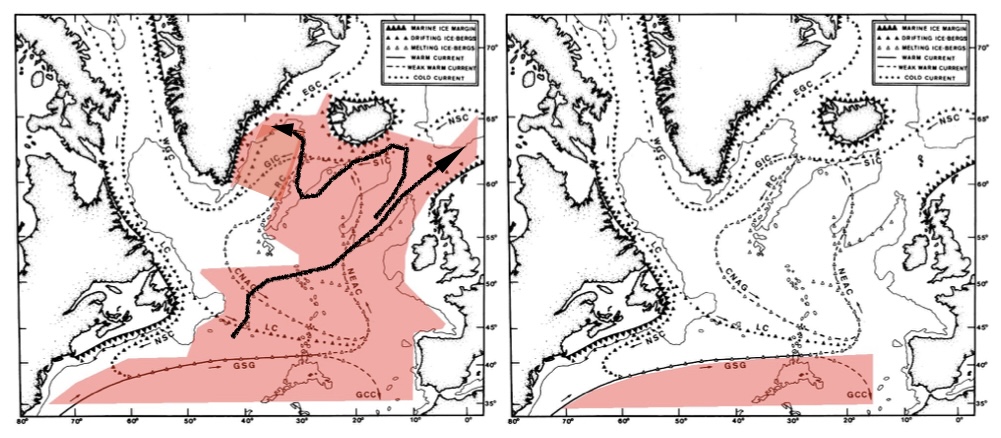
Today warm, salty water from the Gulf Stream reaches across the entire subpolar North Atlantic via the North Atlantic Current (NAC) around the Iceland Basin and Irminger Sea (left panel). Only the Labrador Sea and the waters south of Greenland are cold. In contrast, during glacial times when the AMOC was in its ‘off’ state, the North Atlantic Current branch was absent, and the Gulf Stream continued essentially straight across the ocean along roughly 40°N. The entire North Atlantic north thereof was cold (right panel).
The supply of moisture from a warm ocean is the likely reason that precipitation over Greenland is far greater today than it was during glacial times. In those days, the westerlies, which I assume had a more southerly path along the paleo-Gulf Stream, transported moisture toward Europe leading to the huge expansion of glacial ice across the continent. The paleo-Gulf Stream fed the wind-driven subtropical gyre to its south (as it does today) but no NAC.
When we say AMOC shutdown, we mean the cessation of dense water that spills into the deep North Atlantic from the Nordic Seas. The shallow overturning branch continues. Whereas today the shallow overturning takes place in the Irminger Sea, I imagine it shifted farther south closer to the paleo-Gulf Stream where cold winds off the continent and a supply of saltier water from the meandering stream can promote open ocean convection. The Kuroshio Current flows zonally across the Pacific similar to the paleo-Gulf Stream. Can the North Pacific Intermediate Water serve as an analogue to the shallow branch of the AMOC?
The changes at depth are equally dramatic. When the Nordic Seas no longer can export dense water along a deep western boundary current, water from the Antarctic takes over and fills the entire Atlantic from the bottom up to nearly 2 km depth. The following figure from Robinson et al. (2005) illustrates the timing of the deep-sea transitions.
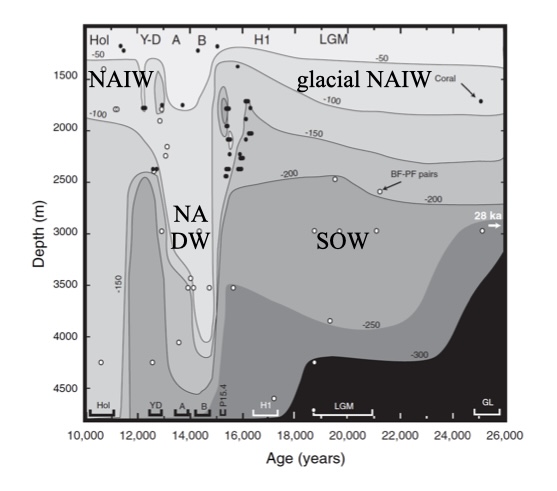
Time goes from right to left. Note the huge changes that take place around 15.000 years ago with the appearance of North Atlantic Deep Water (NADW, dense water from the Nordic Seas) and the brief reappearance of Southern Ocean Water (SOW) during the Younger Dryas ~12,000 years ago when the Nordic Seas overflow ceased. North Atlantic Intermediate water (NAIW), the shallow overturning branch of the AMOC, is present all the time. It is the export of dense water from the Nordic Seas that is key to the state of the AMOC.
Robinson, S. G., M. A. Maslin, and N. McCave (1995). Magnetic susceptibility variations in Upper Pleistocene deep-sea sediments of the NE Atlantic: Implications for ice rafting and paleocirculation at the last glacial maximum. Paleo-Oceanography,10, 221-250
Robinson, L. F., J. F. Adkins, L. D. Keigwin, J. Southon, D. P. Fernandez, S-L Wang, D. S. Scheirer (2005). Radiocarbon Variability in the Western North Atlantic During the Last Deglaciation. Science, 310,1469-1473. DOI: 10.1126/science.1114832