It was 20 years ago this month that Charlie Flagg and I started the Norröna project – and what a project it was! With funding from the National Science Foundation and with the terrific support from Mr. Jógvan i Dávastovu, the master, and technicians onboard we had just installed a 75 kHz acoustic Doppler current profiler (ADCP) in the hull almost halfway back from the bow, the recording instrumentation in a electronics room behind the bridge, and a GPS-compass antenna system topside. Our objective was to measure the flow of warm water into the Nordic Seas between Shetland, the Faroes and Iceland – the important Nordic Seas branch of the Atlantic meridional overturning circulation (AMOC).
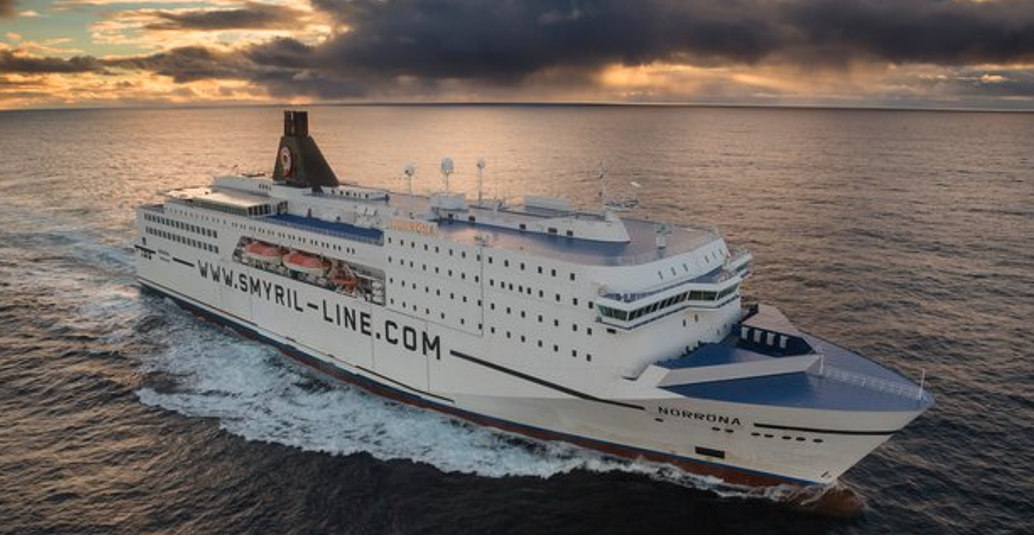
Believe it or not, the equipment worked perfectly as soon as we sailed. That was the good news. But the nightmare that immediately descended upon us was the train of bubbles blocking the ADCP acoustics - that came as a complete surprise. Skipping the details (discussed in the Flagg website, see below), it took 3 years before we started to get data returns in sufficient volume to be scientifically useful. We also installed an AXIS, an autonomous XBT launching system. This combination enabled us to get weekly sections of currents and monthly sections of temperature along both openings to the Nordic Seas – data we have used in numerous studies.
If I could dial the clock back with the knowledge we have gained since then, I’d make every effort to restart the project. I am convinced that by positioning the ADCP near the centerline just behind the bow thruster openings (the source of bubble-drawdown), we can avoid the bubbles and get first-class ADCP data. If bubbles are still an issue, we could use a fairing or chines, but experience from the CV Oleander leads me to think this may not be necessary.
The Nordic Seas AMOC is the climatologically important branch of the AMOC system. Because all warm water enters to either side of the Faroes, the Norröna captures it all on its weekly transits across these passages. This is an incredibly cost-effective method to keep track of the strength of the AMOC. The combination of velocity and temperature allows for accurate estimates of heat fluxes, and by keeping track of salinity change also freshwater fluxes, valuable information with respect to the overturning in the Nordic Seas. Keeping track of salinity is essential. If it decreases over time while temperature is increasing we may anticipate a reduction in dense water production, and hence the AMOC. But so far as I know no such trend has been detected. Conversely, if salinity is increasing over time (due to increased evaporation at lower latitudes) then the Nordic Seas overturning should remain strong.
While we can and should monitor the state of the Nordic Seas for changes in water properties that might portend a change in AMOC strength, for any such change to become detectable will require significant change in volume/heat transport into the Nordic Seas over a lengthy period of time. Why not measure those fluxes directly and get a heads-up on future state changes? The OSNAP and ASOF programs would benefit from knowing – in real time – fluxes across the ridge.
Charlie Flagg’s website gives a comprehensive overview of the Norröna installation and the bubble problems we faced: http://po.msrc.sunysb.edu/Norrona/
This paper concludes the Norröna project and puts its findings into the larger context of Nordic Seas exchange:
Rossby, T., C. Flagg, L. Chafik, B. Harden, and H. Søiland (2018). A direct estimate of volume, heat, and freshwater exchange across the Greenland-Iceland-Faroe-Scotland Ridge. Journal of Geophysical Research: Oceans, 123. https://doi.org/10.1029/2018JC014250